
What the November 2025 jobs report means for employers
The November 2025 jobs report shows a labor market that continues to move sideways. Job growth remained modest, overall employment levels changed little, and hiring activity stayed concentrated in a limited number of sectors.
For employers, this points to a market where hiring is still possible, but conditions are unlikely to loosen or tighten quickly. Planning for steady, uneven conditions—rather than a near-term rebound or decline—remains the most practical approach.
Key takeaways from the November 2025 jobs report
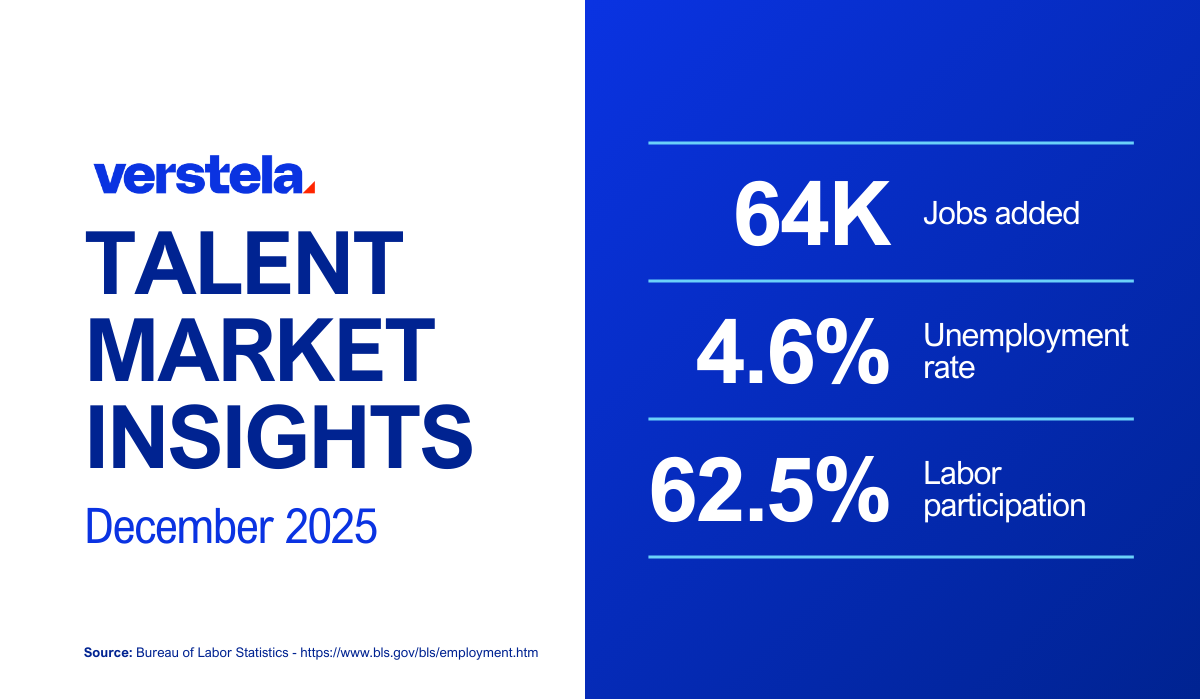
- 64,000 jobs were added in November. Total nonfarm employment has shown little net change since April.
- Unemployment was 4.6%, with 7.8 million people unemployed. Both measures were little changed from September and are higher than a year ago (4.2% and 7.1 million).
- Labor force participation held at 62.5%, and the employment-population ratio remained 59.6%.
- Average hourly earnings rose 0.1% in November and are up 3.5% over the past year. Production and nonsupervisory workers saw a 0.3% increase.
- August and September payroll gains were revised down by a combined 33,000.
Overall, the data reflects a stable labor market with limited momentum and narrow job growth.
Job growth by sector
Job gains in November continued to be concentrated in a small number of industries.
- Health care: +46,000
- Ambulatory health care services: +24,000
- Hospitals: +11,000
- Nursing and residential care facilities: +11,000
- Construction: +28,000
- Nonresidential specialty trade contractors: +19,000
- Social assistance: +18,000
- Individual and family services: +13,000
Job losses occurred in:
- Transportation and warehousing: –18,000
- Couriers and messengers: –18,000
- Federal government: –6,000
- Down 271,000 since January
Most other major industries—including manufacturing, wholesale trade, retail trade, professional and business services, leisure and hospitality, financial activities, and information—showed little or no change.
For light industrial and logistics employers:
Transportation and warehousing employment has declined by 78,000 since peaking in February, which may influence talent availability and movement across related roles in logistics-heavy markets.
Unemployment and labor force participation
The unemployment rate was 4.6% in November, with 7.8 million people unemployed. Both measures are higher than a year earlier.
Additional labor supply indicators include:
- Long-term unemployed (27+ weeks): 1.9 million, or 24.3% of all unemployed
- People not in the labor force who currently want a job: 6.1 million
- Marginally attached to the labor force: 1.8 million
- Discouraged workers: 651,000
The labor force participation rate (62.5%) and employment-population ratio (59.6%) were little changed over the month and over the year.
Wage growth
Wage growth remained moderate in November.
- Average hourly earnings: up 0.1% in November; up 3.5% over the past year
- Production and nonsupervisory workers: up 0.3% in November
What employers can do now
With labor market conditions holding steady, employers may benefit from planning around continued variability rather than short-term change.
Focus hiring on operational impact
With overall job growth limited, prioritize roles that directly support production, safety, service levels, and delivery commitments. Targeted hiring can help maintain performance without overextending teams.
Design roles for stability and predictability
The increase in part-time employment for economic reasons suggests some workers are seeking more consistent hours or clearer full-time pathways. Reviewing schedules, shift structures, and role expectations may help attract and retain talent.
Anticipate talent movement across related roles
Declines in transportation and warehousing may affect candidate availability in logistics-heavy regions. Employers may benefit from recognizing transferable skills and adjusting onboarding or training to support transitions into light industrial roles.
Review compensation and workload alignment
Moderate wage growth provides an opportunity to reassess pay ranges, overtime usage, and workload distribution—especially where roles have evolved or absorbed additional responsibilities.
Build flexibility into workforce plans
When demand is difficult to forecast, temporary and project-based staffing can help manage fluctuations without long-term commitments. This approach allows employers to maintain productivity while staying responsive to changing conditions.
Employer outlook
Current labor market patterns suggest continued steadiness with limited growth.
- Health care and social assistance remain primary sources of job gains
- Transportation, warehousing, and federal employment continue to face declines
- Labor force participation remains stable but has not increased
For employers, success will depend less on reacting to monthly data and more on operating effectively within sustained, uneven conditions.
Put insights into action
At Verstela, we help employers translate labor market data into practical workforce decisions.
We support organizations with:
- Local labor market insights
- Staffing strategies for light industrial and logistics roles
- Flexible staffing solutions to manage changing demand
→ Explore Employer Resources for tools and insights
→ Connect with our team to talk through what this report could mean for your hiring and workforce strategy