
The U.S. Bureau of Labor Statistics (BLS) February jobs report shows a labor market that remained stable overall, though hiring slowed compared to January.
Total nonfarm payroll employment declined in February following job growth the previous month. Most major industries—including manufacturing, construction, and retail—showed little change.
For HR and operations leaders, the data points to a labor market moving at a steady pace, with limited large-scale hiring or layoffs across many sectors.
Key takeaways from the February 2026 jobs report
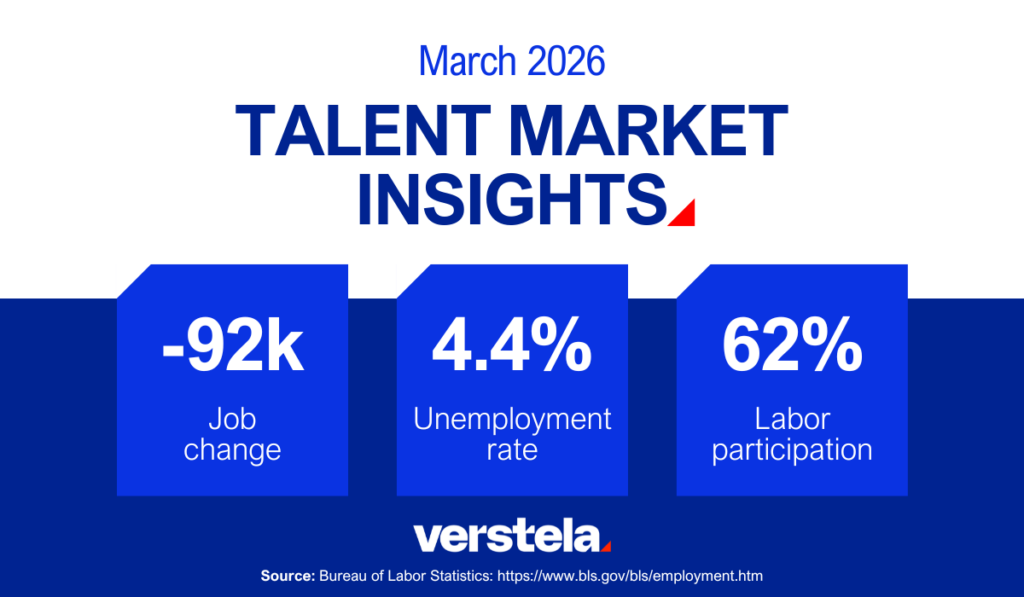
- 92,000 jobs were lost in February, following 126,000 jobs added in January.
- Unemployment was 4.4%, little changed from the previous month.
- Labor force participation was 62.0%, essentially unchanged.
- Average hourly earnings increased 0.4% in February and were up 3.8% over the past 12 months.
- Average workweek was 34.3 hours.
Overall, the data shows that the labor market experienced a modest pullback in February after job growth in January, with employment changes varying across industries.
Job growth by sector
Employment changes in February were concentrated in a few industries.
Industries adding jobs:
- Social assistance: +9,000
Industries losing jobs:
- Health care: –28,000 (largely related to strike activity)
- Information: –11,000
- Federal government: –10,000
Industries with little or no change:
- Manufacturing
- Construction
- Wholesale trade
- Retail trade
- Professional and business services
- Leisure and hospitality
- Mining, quarrying, and oil and gas extraction
- Transportation and warehousing
Unemployment and labor force participation
The unemployment rate was 4.4% in February.
Additional labor supply indicators include:
- Long-term unemployed (27+ weeks): 1.9 million
- People working part time for economic reasons: 4.4 million
- People not in the labor force who want a job: 6.0 million
- Marginally attached to the labor force: 1.6 million
- Discouraged workers: 366,000
Labor force participation and employment levels have shown little movement over the past year.
Wage growth and hours worked
Wage growth continued at a moderate pace in February.
- Average hourly earnings: up 0.4% in February and 3.8% over the past 12 months
- Average workweek (all private employees): 34.3 hours
Stable hours across industries suggest that many employers are maintaining consistent production schedules rather than expanding or reducing workforce levels.
For employers, that points to a labor market where day-to-day workforce decisions may matter more than broad hiring changes.
What employers can do now
Improve staffing efficiency
Many employers are paying closer attention to scheduling, shift coverage, and attendance trends to help maintain output and identify early shifts in demand.
Maintain workforce stability
When hiring activity slows, workforce stability becomes increasingly important. Reducing turnover, improving attendance, and maintaining consistent staffing levels can help prevent disruptions in daily operations.
Build flexibility into staffing plans
Maintaining a stable core team while using flexible staffing options allows organizations to adjust coverage when demand shifts. Temporary or on-demand staffing can provide additional support during volume increases without requiring permanent headcount changes.
Continue investing in recruiting and retention
Consistent recruiting efforts help maintain a strong talent pipeline so organizations can respond quickly when hiring demand increases.
Put insights into action
At Verstela, we help employers turn labor market data into practical staffing decisions.
We support organizations with:
- Local labor market insight
- Staffing strategies aligned with current hiring conditions
- Flexible staffing support to manage changing demand