
The December jobs report reflects a labor market that continues to hold steady, with limited overall movement. Hiring activity remains uneven across industries, and conditions are not changing quickly in either direction.
For employers, this points to a continued need for stable workforce planning, with an emphasis on flexibility and managing through ongoing variability rather than expecting near-term shifts in labor availability.
Key takeaways from the December 2025 jobs report
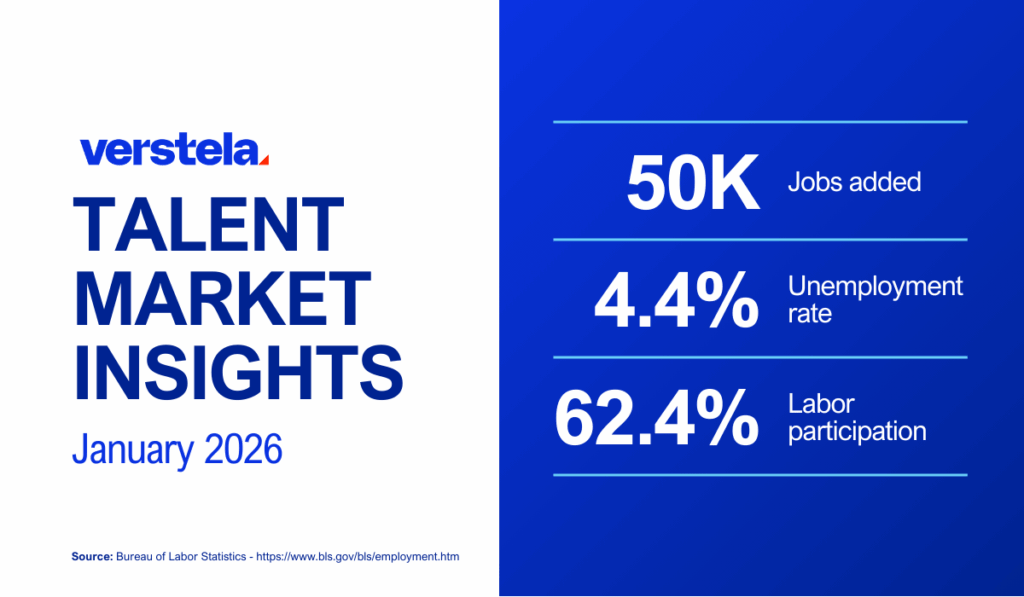
- 50,000 jobs were added in December. Total nonfarm employment increased only slightly over the month.
- Unemployment was 4.4%, with 7.5 million people unemployed, changed little from November.
- Labor force participation was 62.4%, and the employment-population ratio was 59.7%, remaining essentially flat over the month and year.
- Average hourly earnings increased 0.3% in December and were up 3.8% over the past 12 months.
- October and November payrolls were revised down by a combined 76,000 jobs.
Overall, the data reflects a labor market that is holding steady, with slower job growth compared to the prior year and limited movement across most industries.
Job growth by sector
Job gains in December continued to be concentrated in a small number of industries.
Industries adding jobs:
- Food services and drinking places: +27,000
- Health care: +21,000
- Hospitals: +16,000
- Social assistance: +17,000
- Individual and family services: +13,000
Industries losing jobs:
- Retail trade: –25,000
- General merchandise retailers: –19,000
- Food and beverage retailers: –9,000
Industries with little or no change:
- Manufacturing
- Construction
- Transportation and warehousing
- Wholesale trade
- Mining, oil, and gas
- Professional and business services
- Financial activities
- Information
- Federal government
For light industrial and manufacturing employers
Employment in manufacturing and transportation and warehousing showed little change in December. Average weekly hours in manufacturing declined slightly, which may reflect adjustments in scheduling rather than changes in headcount.
Unemployment and labor force participation
The unemployment rate remained at 4.4% in December.
Additional labor supply indicators include:
- Long-term unemployed (27+ weeks): 1.9 million, or 26.0% of all unemployed
- People unemployed less than 5 weeks: 2.3 million
- People working part time for economic reasons: 5.3 million, up nearly 1.0 million over the year
- People not in the labor force who want a job: 6.2 million
- Marginally attached to the labor force: 1.8 million
- Discouraged workers: 461,000
Labor force participation and employment levels have shown little change over the past year.
Wage growth and hours worked
Wage growth remained moderate in December.
- Average hourly earnings: up 0.3% in December; up 3.8% year over year
- Production and nonsupervisory workers: little change in December
- Average workweek:
- All private employees: 34.2 hours
- Manufacturing: 39.9 hours
- Overtime in manufacturing: unchanged at 2.9 hours
What employers can do now
With labor market conditions remaining steady and growth uneven across sectors, employers may benefit from planning around consistency.
Plan for steady hiring needs
Limited overall job growth suggests hiring conditions may remain similar in the near term. Employers can focus on maintaining staffing levels needed to support operations and service expectations.
Monitor hours and part-time trends
The increase in part-time employment for economic reasons may indicate workers seeking more stable or predictable hours. Clear communication around schedules and expectations can support retention.
Recognize transferable skills
Employment shifts across industries may affect candidate availability in some markets. Transferable skills across roles can help broaden candidate pools for light industrial positions.
Use flexible staffing
Temporary and project-based staffing can help manage changes in demand while maintaining productivity and operational stability.
Put insights into action
At Verstela, we help employers translate labor market data into practical workforce decisions.
We support organizations with:
- Local labor market insights
- Staffing strategies for light industrial and logistics roles
- Flexible staffing solutions to manage changing demand